
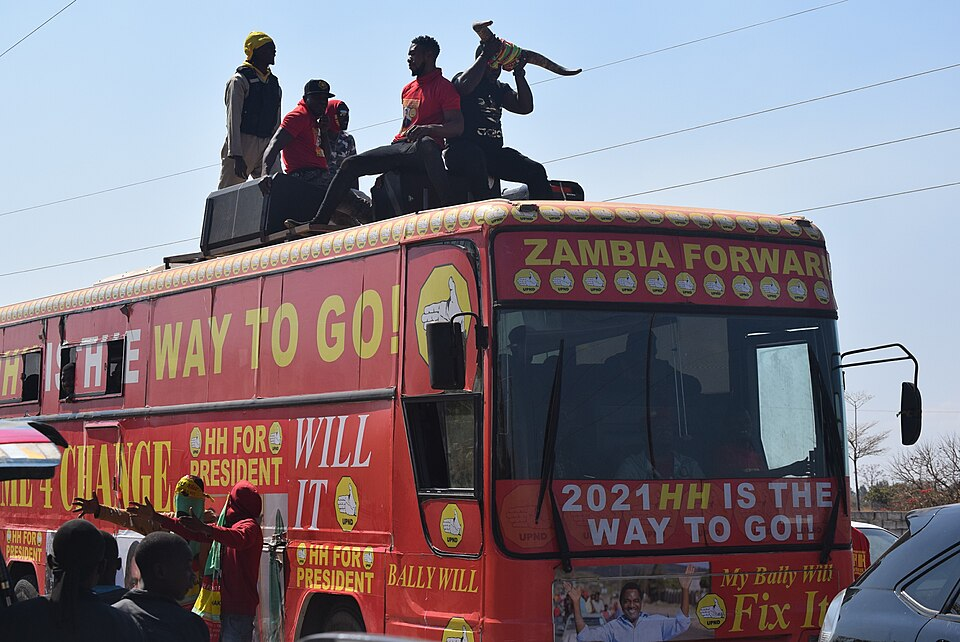
UPND (liberal) supporters in Zambia, circa 2021
Icem4k, CC BY-SA 4.0 <https://creativecommons.org/licenses/by-sa/4.0>, via Wikimedia Commons
File:UPND Suppoters 16.jpg – Wikimedia Commons

Zambia is gearing up for general elections to be held on 13 August 2026. The incumbent president, Hakainde Hichilema (UPND, liberal), is running for a second five-year term.
Zambia has a V-Dem electoral democracy rating of 0.50/1, putting it on the threshold of being considered an “electoral democracy” according to V-Dem. V-Dem’s appraisal fell by one point since the 2025 report was released. While there is an opportunity for Zambia to consolidate its democratic status, assuming that the elections are free and fair, it is also possible that Zambia’s V-Dem rating could slip slightly below this threshold if it doesn’t fully meet international standards.
Background
The 2021 Presidential election was essentially a rerun of the one held in 2016. In the 2016 election, incumbent President Edgar Lungu (PF, centre-left) won with 50.3% of the popular vote, narrowly avoiding a runoff. Hichilema challenged the results in court, but his case was ultimately thrown out.
Hichilema stood as a candidate again in 2021. However, citing the ongoing COVID-19 pandemic, Lungu’s government implemented restrictive tactics. Opposition campaigns were heavily restricted through a ban on political rallies, opposition media outlets were barred and the internet was out sporadically on election day.
Ultimately, Hichilema prevailed in 2021, officially winning with 57.5% of the vote compared to 37.7% for Lungu. After an initial rejection of the polling results, Lungu eventually conceded the election.
Since taking office, Hichilema has embarked on an economic and political reform program. Hichilema began negotiations with the IMF, promised stronger anti-corruption measures and other political reforms, and announced that major sectoral reforms and public sector reforms would be a priority. Since 2021, many of the public sector and economic reforms have been fully or partially implemented, while governance reform, especially regarding the new electoral system, has drawn scrutiny.
However, while inflation has fallen from a high iof 24% in August 2021 to 6.5% in June year over year, it remains a key issue for Zambian voters. GDP per capita has not improved significantly and the country still depends heavily on copper, making up around 70% of Zambia’s total export value.
New Electoral System
The electoral system for the parliament was recently changed via a constitutional amendment introduced in 2025. Before the change,156 parliamentarians were chosen in single-member districts using first-past-the-post, the president appointed eight, and the remaining three went to the Vice President, the Speaker of the Natioanl Assembly, and a deputy speaker.
The 2025 amendment increased the number of total parliamentarians to 280. 226 of the members will be elected using first-past-the-post. An additional 40 will be elected from nationwide party lists using proportional representation, of which 20 are reserved for women, 15 for youth, and five for persons with disabilities. Parties contesting these seats are required to submit separate lists for each category. The Vice President, Speaker, and Deputy Speaker would retain their parliamentary seats, and the number of presidentially appointed seats has increased to 11.
These changes came with some criticism, however. Some critics of the amendment were concerned about the potential for the ruling UPND party to pick up seats due to the way the proposed districts were drawn. While Hichilema and the UPND have stated that they sought to promote inclusivity, the manner in which the reforms were carried out contributed to the controversy.
The Candidates
Before he died in 2025, Lungu sought to make it on the ballot for the 2026 presidential race. However, Zambia’s Constitutional Court ruled that Lungu had already served two terms, first between 2015 and 2016, after the death of his predecessor, Michael Sata (PF, centre-left), and then between 2016 and 2021. This was a reversal of the Court’s ruling in 2021 that Lungu could have stood for re-election because the 2015-2016 term, according to the new ruling, counted as a full term. Notably, the Court did not nullify the results of the 2021 election.
Aside from Hichilema, three other candidates are generally considered to be the frontrunners. These are Brian Mundubile (Tonse, centre-left), Fred M’membe (PP, left), and Harry Kalaba (CF,centre-right). Munduubile’s Tonse alliance is considered the main opposition, in part due to the initial participation of Lungu’s PF in the alliance. M’membe’s left-wing People’s Pact is seen as an umbrella for Zambia’s left-wing parties. Finally, Kalaba is a former foreign minister and has previously participated in the 2021 election, placing third behind Hichilema and Lungu.
Civil liberties controversies
Since 2025, a series of laws ostensibly aimed at securing public order and addressing cyber security have drawn criticism from rights groups. The 2026 Public Gatherings Act requires “public gatherings” to give advance notice to a police officer at least five days before the planned gathering. Critics argue that despite formal protections for civic gatherings, the Zambian government still has an inordinate amount of power over protests.
The 2025 Cyber Crimes Act, as its name suggests, is intended to address various types of cyber crimes. Critics here have also argued that material considered “obscene” or “vulgar” would fall under the act as well as disclosures linked ot “critical information,” related to journalistic freedom. The Cyber Crimes Act has since been challenged by the Law Association of Zambia in a High Court suit.
Analysis
Like elsewhere, Zambia’s electoral rules will heavily shape the outcome. Zambia uses a two-round system for the president, where a candidate must win 50% of the vote + 1 vote to win outright. If no candidate reaches this threshold, the top two candidates advance to a second election.
As of this writing, the formal threshold for winning proportional list seats, if there is even to be one, has yet to be settled. It is currently unclear what that threshold might be. It could be negligible, around 1-2 %, or substantial (10-20%), or somewhere more in line with international standards at 5 percent, for example. Low or non-existent thresholds are sometimes intended to fragment the opposition, while high thresholds frequently serve to consolidate the party system and lock out minor opposition parties.
Because the opposition is fragmented, however, Hichilema is likely to win the first round of voting, even if he doesn’t manage to avoid a runoff.
The parliamentary elections are likely to result in a large plurality, if not a majority, for the UPND. A divided opposition in a legislature where most of the seats are won by plurality would benefit the UPND significantly if opposition parties cannot rally around common candidates in these single-member districts. This has already happened with Tonse and the PF; however, smaller opposition parties may face some difficulty uniting behind common candidates.
Conclusion
The two-round system for the president suggests that even if the opposition is divided, a runoff could be forced, and the opposition could rally around whichever candidate makes it into the runoff, along with Hichilema. The parliamentary elections, however, are more likely to benefit Hichilema’s UPND.
Ultimately, the quality of a country’s political institutions is difficult to assess based on just one election. For Zambia’s institutions, the integrity of the electoral process itself is a more important determining factor than who wins the presidency or parliament in one scheduled election.