
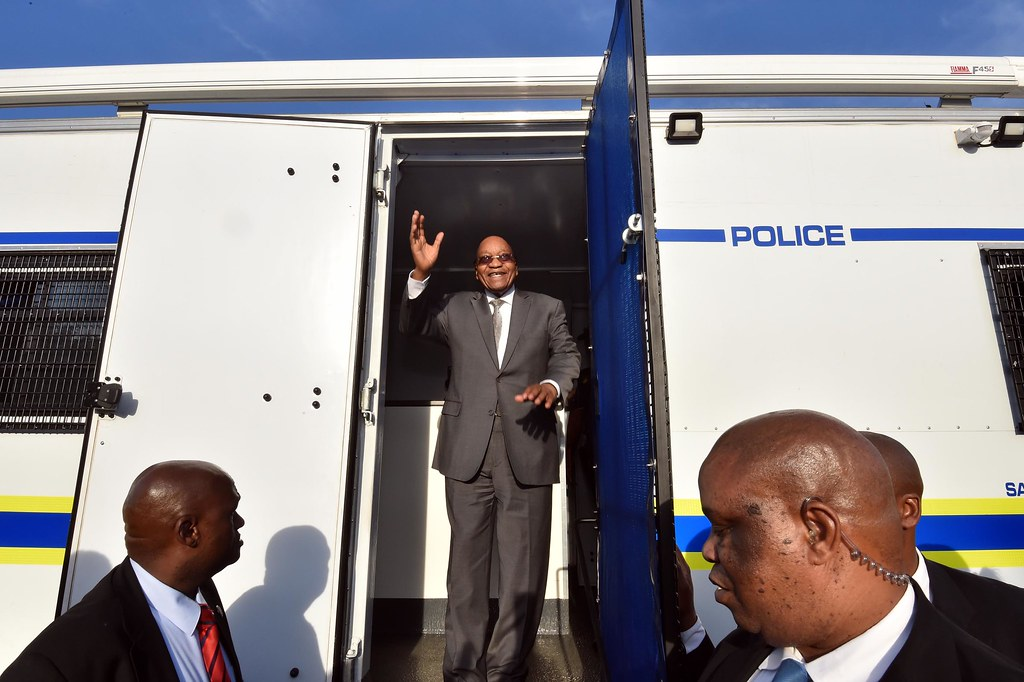
Jacob Zuma in 2017 (GovernmentZA/ CC BY-ND 2.0
Written by Dylan Simpson, contributions from Adrian Elimian
Nestled along the Eswatini border, KwaZulu-Natal (KZN) is a hot, lush province that reflects South Africa’s broader diversity. It is home to large Indian, English, and Coloured communities, though by far its largest community are the Zulus, who make up around 80% of the population. Their distinctive culture and perspectives—shaped by strong communal ties, historical struggles against rival tribes and imperial powers, and deeply rooted traditional leadership structures—have helped create the province’s unique political identity.
The unique demographics and history of the province have at times translated into instability and turmoil, but have always made it an important province politically. The population of the province and the size of the Zulu vote (the largest ethnic group in the country) are simply too large to ignore. As South Africa braces for its May election, all eyes turn to KZN as the ANC faces the prospect of its once-unassailable majority teetering on the brink, largely as a result of an increasing dislike for the ANC in KZN. But why? And will KZN really be what makes or breaks the ANC majority in South Africa?

Background
In 1994, the ANC won the majority of the vote in seven of the eight majority-Black provinces, marking the beginning of ANC dominance in South African politics. But amidst this landslide victory for the ANC, KZN emerged as a considerable outlier. Here, the ANC faced substantial opposition from one other political force, the Inkatha Freedom Party (IFP, conservative). The IFP had been one of the key movements against Apartheid. Formed in 1975, the party and its leader Mangosuthu Buthelezi controversially worked within the Bantustan system and protest movement to combat apartheid while also fighting to safeguard the position of Zulus. The party advocated for a conservative constitution that guaranteed the position of the Zulu royal family and traditional values, calling the first drafted liberal constitution the ANC put forward, an “abortion of a constitution.” When divides between the ANC and Inkatha grew over ethnicity, political ideology and tactics, the apartheid state fomented bloodshed between them, funnelling weapons and money to the IFP, with the ensuing violence on both sides costing tens of thousands of lives. When the IFP finally agreed to contest the first democratic election, it ran on a similar platform whilst advocating for further local devolution. Yet within a few election cycles, the party declined to near irrelevance, having its support more than halved nationally, being reduced to a shadow of its former self. But why did this happen?
The Zuma Factor
The answer largely rests with one man, former ANC President Jacob Zuma.
Born into a poor Zulu family in KZN, radicalised by oppression from the Apartheid state, Zuma joined the ANC aged 17. In 1962, he joined the ANC’s armed wing, uMkhonto we Sizwe (MK), a decision that would eventually lead to his decade-long incarceration on Robben Island alongside ANC members like Nelson Mandela and Kgalema Motlanthe. Once released, Zuma further immersed himself in organising efforts within the ANC and its armed wing, particularly in his home province of KZN. He grew a devoted following and quickly moved up the party into key leadership positions, later becoming a member of the ANC national executive and then head of intelligence.
His ascent within the ANC continued at a rapid pace during the transition to democracy. In 1994, Zuma was elected ANC National Chairperson before becoming Deputy President in 1999, to the great disdain of the then-President, Thabo Mbeki. The relationship between Mbeki, a Xhosa man from an influential political family who was firmly inside the centrist liberal wing of the ANC, and Zuma, a traditional conservative Zulu and a supporter of much more radical socialist economics, was fraught with tension, personal grudges, and near-constant political infighting. This bitter rivalry only deepened during the Arms Deal Scandal, when Zuma was removed as Deputy President by Mbeki after Zuma and several other senior ANC politicians were accused of illegally buying unneeded military equipment in exchange for bribes. The move to remove Zuma from such a powerful position was seen as politically motivated amongst Zuma’s allies and much of the media, especially as other senior politicians implicated in corruption scandals were not given the same treatment.
Yet in 2007, Zuma’s political fortunes underwent a remarkable turnaround. Exploiting Mbeki’s waning popularity within the ANC over his centrist economics and isolated leadership style, Zuma was able to galvanise the ANC to elect him as President of the party, beating Mbeki by a comfortable margin at a party conference, forcing Mbeki to resign as President and leading to an exodus of more centrist ANC figures from the party.
Upon becoming President, Zuma embraced his Zulu identity with his signature slogan of “100% Zulu boy” and championed more conservative values. He flaunted his polygamous marriages — a tradition rooted in large parts of Zulu culture, promoted and funded traditional medicines, and gave more power and autonomy to tribal authorities, all while publicly forging closer ties with the Zulu royal family. His disapproval of gay rights, including boasting about assaulting gay men as well as his disparaging comments about single mothers and teenage pregnancies, while controversial and disliked by many, did appeal to large parts of the conservative rural areas of KZN. This identity-based politics massively grew the ANC’s popularity in the Zulu community, eating away at the IFP’s support while maintaining the allegiance of the left of the ANC.
The impact of Zuma’s support amongst Zulu voters was massive. The surging growth in ANC support amongst the group, particularly in KZN, provided a strong buffer against challenges posed by the decline in ANC support in other provinces and demographics, particularly Coloured and young Black voters.
If in 2009 the ANC received the same number of votes in KZN as it did in 2004 (assuming the same provincial turnout), the party vote share would have fallen nationally to 60% (as opposed to 66%). If the ANC received the same vote share in 2014 in KZN as it did in 2004, then its vote share would have declined to 55% (as opposed to 62%). Zulu voters thus became a far more consequential part of the ANC voter coalition, with KZN dethroning Gauteng as the province with the most ANC voters. The ANC’s majority under Zuma now relied on KZN’s voters in a way it had not under Mandela or Mbeki, massively changing the political landscape and campaign strategy of the ANC.
For many first time ANC voters in KZN, a vote for the ANC was less about the party itself, but more so about Zuma and the Zulu identity he represented.
Zuma’s fall from grace
The allegations of corruption laid against Zuma frequently caused chaos within his own party. There are several dozen damaging corruption allegations that could be listed, but the two most prominent scandals while he was President were the Nkandla debacle and Guptagate.
In 2013, a story broke that Zuma had spent over 246 million rand of taxpayer and foreign aid money on “Security upgrades” for his estate in Nkandla. These additions included new kitchens, a chicken run, a cattle kraal, a marquee, several houses for relatives, and a helipad. Most damaging to his political standing was the allegation that he installed a large “fire-safety” pool in his back garden. Even after ANC officials lied, saying that these “upgrades” either didn’t exist or were legitimate, the public damage and legal challenges to Zuma forced him to eventually pay back the vast majority of the public funds spent on his homestead. His image of a humble man from a poor background was massively damaged.

However, the scandal which was the most detrimental to Zuma’s relationship with his party was the Guptagate scandal. The scandal revolved around President Zuma’s corrupt relationship with the Indian billionaire Gupta family. It was alleged that after they first met in 2003 they formed a corrupt business alliance between them. The Guptas provided huge political and financial support to Zuma, funding his campaigns, personal lifestyle, and even giving his family members key positions at their companies. In exchange for these inducements, Zuma would give the Gupta family all manner of looting rights, including free rein over government contracts, tax breaks, and paid for security. Most shocking, however, was their alleged ability to handpick members of Zuma’s cabinet, leading to a record-breaking 12 cabinet reshuffles during his time in office, including those affecting the mining and finance ministries—sectors in which the Guptas had significant investments.
When revealed to the public, outrage was swift. Julius Malema, the leader of the Economic Freedom Fighters (EFF, left-wing) and a former ally of Zuma declared that the Gupta family had “de facto colonised South Africa, with Zuma being the chief colonial administrator.” But it was not just the opposition that was left enraged by these allegations of Gupta influence. Many ANC MPs felt sidelined, especially those who had been removed from Zuma’s cabinet or felt their party’s support crumble under the weight of damaging scandals. Zuma became increasingly isolated inside the ANC, relying more and more on the backing of a shrinking socialist faction, largely from KZN and those tied to him through alleged corrupt business dealings.
The growing wave of scandals eventually led the ANC’s National Executive to recall Zuma, forcing him to resign as president or face a no-confidence vote in parliament. Seeing the writing on the wall and the humiliating possibility of being the first democratically elected president of South Africa to lose a vote of no-confidence, Zuma resigned.
But these troubles would only get worse for Zuma. The many legal battles he fought would suddently catch up to him. In 2021 he was charged and convicted of contempt of court after he failed to show up to a panel on financial corruption. Although given a relatively light sentence of 15 months, it meant that he was legally barred from running as an MP. Outrage from his supporters, with the arrest being seen by them as proof of Zuma’s allegations of a white capitalist conspiracy to oust him, combined with the desperate poverty of many South Africans led to a series of explosive riots and mass looting, leaving over 300 dead.
The ANC without Jacob Zuma
The electoral implications in KZN of an ANC without Zuma at the helm emerged quickly. Despite the new President Cyril Ramaphosa having high approval ratings, ANC support in the province fell, with the EFF and IFP making significant gains in 2019 through a combination of Zuma supporters switching to them or staying at home. In the 2021 local elections, this electoral shift was accelerated. The IFP made big inroads into the Midlands area of KZN and regained some of their heartlands that had been lost to the ANC under Zuma. The DA was even able to take the black majority municipality of Umgeni in rural KZN, a place which had never voted for any other party except the ANC in its history.
Things only got worse for the ANC. By-election after by-election in the province from 2022 onwards showed the ANC sustaining big losses to the IFP in majority-Zulu wards, with the ANC falling to below 50% provincially in several polls in 2023. The four large polls done between May and December 2023 showed the average results of the ANC to be just 37%, a far cry from the Zuma-era peak of 64% just 9 years prior. Yet a political bombshell unleashed by Zuma turned the ANC’s situation from bad to catastrophic.
The Return of Zuma
Using the name of the ANC’s previously mentioned armed wing, uMkhonto we Sizwe (MK), a hitherto unknown figure, Jabulani Sibongiseni Khumalo—who had no significant political experience—launched the MK Party in September 2023. Khumalo has claimed he was a former ANC member and MK veteran, however little evidence has been provided to corroborate his claims and several ANC members and MK veterans have denied this. The party was little known and irrelevant, until in December 2023 Zuma publicly endorsed the party in a fiery speech, calling the ANC a party “led by sellouts and apartheid collaborators.” The MK party has little formal structures, and its leadership details are murky. Senior positions are filled almost entirely by close Zuma allies who’ve left the ANC or EFF. In April 2024, the party announced Jacob Zuma as its de jure leader, while key figures within MK—including its founder, Jabulani Khumalo—were removed. The question of who is actually funding the party remains opaque, with little transparency around its financial backers and growing speculation about the sources of its support. Jacob Zuma has been given another boost recently when a court overturned an earlier IEC ruling that found he couldn’t run for parliament, enabling him to sit as an MK party MP after the elections.
On policy, the MK party had been very light on detail until recently, largely focusing on the personality of Zuma to gain traction. Its newly unveiled manifesto supports an economically left-wing populist agenda aimed at righting the historical wrongs of apartheid. It wants an “end to austerity and neoliberalism” with a massive increase in government spending on public services and wants to nationalise all the major banks, redistribute land without compensation, and also impose tariffs on more foreign goods.
On social issues, MK have criticised South Africa’s “liberal constitution” and want to give more powers to traditional monarchs through a new lower house of parliament. The party supports a curriculum that promotes “African values and morals with special attention to gender relations” and a “national education programme focusing on African spiritual and moral values.” Zuma has also called gay marriage undemocratic and against the values of traditional African leaders. Moreover, Zuma has stated that the MK party will send pregnant teenagers off to the Robben Island prison where they will be made to complete “university studies.” He went on to say that the child of a pregnant teenager is “not a life, it’s a disease.”
The MK party has aligned its foreign policy with anti-western Governments, expressing support for Putin’s war in Ukraine, as well as for the people of Palestine and Cuba. The MK party also includes a strong commitment to tackling illegal immigration and strengthening the border, arguing that doing so would reduce overcrowding and crime. In short, the party includes multiple aspects of populism, criticising existing liberal institutions, supporting socialist economics and promoting conservative social values.
Looking at polling and by-elections can reveal that amongst much of Zuma’s traditional base there is strong support for the MK party. The 3 by-elections which the MK party have performed the best in (all Zulu majority wards) have shown them making big gains off the ANC, IFP and EFF. They received 20% in AbaQualisi, 28% in Govan Mbeki and 28% in Newcastle, these results being broadly in line with provincial polling and subsamples. In the two non-majority Zulu wards they have contested, they have failed to achieve more than 2% of the vote.
Although hurting the IFP and EFF, reversing many of their gains and taking many of their supporters, the party’s existence is truly a nightmare for the ANC. If the trends seen in polling and by-elections repeat themselves on election day, they are set to take hundreds of thousands of votes from the ANC.
Electoral shifts and looming Coalition Chaos
The MK party has significantly changed the landscape of South African politics. The size of Zuma’s Zulu base means that even if he is disliked by most of the public, the loyalty of his core supporters leaving the ANC could slice 10% off their national support, while also significantly bruising the EFF and IFP. The ANC’s voter coalition cannot sustain a huge number of Zulu voters leaving the party. Before the creation of the MK party, the debate was centred on if the ANC was going to fall below 50%, now the debate is not if, but instead by how far below 50% they will fall?
In KZN, the fragmentation of the Zulu vote among four major parties carries significant ramifications in terms of the electoral performance of all parties and coalition agreements. No major party will find it easy to find comfortable ideological or political partners to govern with and there is no easy way for any party to get over 50%. A lot hinges on the motivations of the MK party and if the personal rift between Zuma and the ANC is too large for them to govern together; if that is the case, the ANC will have to go with the IFP or DA to stay in power, but with that, ideological differences may get in the way. Whether the ANC is amenable to forming a coalition with a party whose leadership has historically engaged in acrimonious conflicts with them remains uncertain.
Nationally, a similar, but less dramatic picture emerges. If the ANC wishes to stay in government, they can no longer look to just some of the smaller progressive parties, which could have been possible when they were polling in the high 40s. Now given the huge number of votes the MK party is set to win, to stay in power, the ANC must reach out to parties like the EFF, DA, IFP or even MK — or some combination thereof — to form a government. In recent weeks, the possibility of an ANC-DA coalition seems even more likely, with the Multi-Party Charter — a coalition agreement between several opposition parties — still failing to get above 50% and the DA increasingly anxious about a potential MK-EFF-ANC coalition.
However, making grand predictions about coalitions will be tricky given we don’t know what the results will be and what the personal ambitions or relationships between parties will be. All that is certain is that the ANC will lose its majority as a result of Zulu voters flocking to the new MK party. The era of total political dominance for the ANC has come to a chaotic end. Through years of supporting Jacob Zuma and overlooking his identity-based Zulu politics the ANC have created their own electoral demise. Now with Zuma’s steadfast determination to catapult the MK party into parliament, they have little way of keeping the Zulu voters Zuma initially brought them.