
For those who follow South African politics, it is hard not to feel a sense of déjà vu with the build-up to this local government election feeling remarkably similar to the last few. Just as in 2024, more than 70% of South Africans believe their country is heading in the wrong direction. Meanwhile, polling suggests that the African National Congress (ANC, centre-left), which has governed South Africa (SA) since 1994, faces yet another record electoral decline, following its already historic 17-percentage point collapse in support at the 2024 national elections, where it incurred significant losses to uMkhonto we Sizwe (MK, left-wing|conservative) and falls in turnout amongst Black voters.
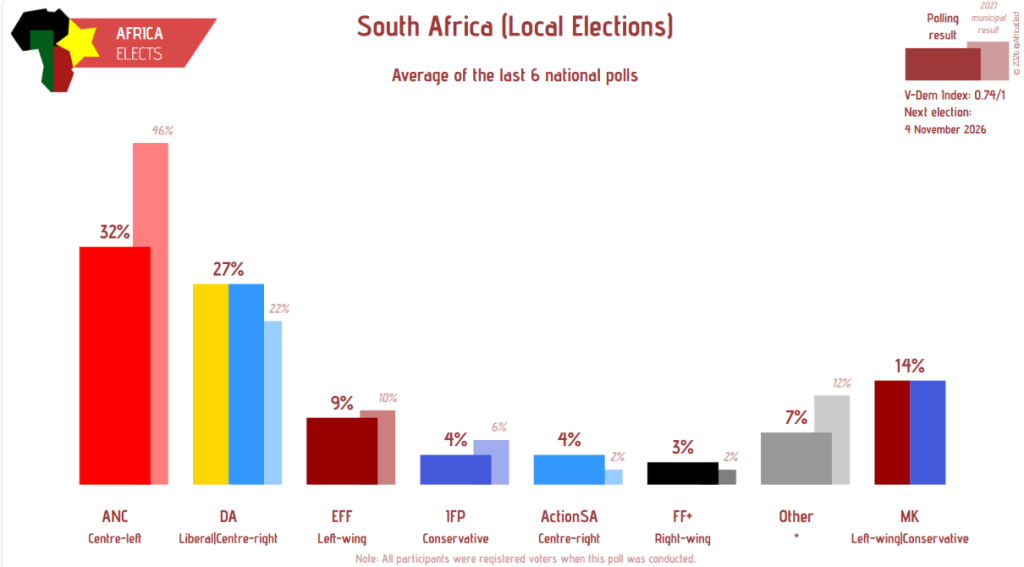
The story behind the ANC’s decline has changed strikingly little. Crime remains rampant, corruption scandals continue to dominate headlines, public services deteriorate and the economy remains stagnant. For millions of South Africans, the problems that shaped their votes in 2021 and 2024 remain unresolved.
The ANC has now suffered two consecutive consequential electoral blows. In 2021, its share of the vote fell below 50% for the first time. Three years later, it lost its parliamentary majority, bringing an end to three decades of uninterrupted majority governance. Now it sits as the largest party in a grand coalition dubbed the Government of National Unity (GNU) with its longtime rival, the Democratic Alliance (liberal|centre-right) alongside eight other parties.
Yet despite these political upheavals, the key issues driving voters away from the ANC have remained stubbornly consistent. While the GNU initially brought on a brief uptick in optimism amongst ordinary citizens, South Africans quickly returned to pre-GNU levels of pessimism. Years of perceived government failure have eroded public confidence, while repeated promises of renewal have brought little change to voters’ daily lives or to the ANC’s declining fortunes.
As South Africa approaches another historic election, the question is whether anything has changed sufficiently to arrest the ANC’s decline, or whether voters will once again deliver the same verdict on the same unresolved problems.
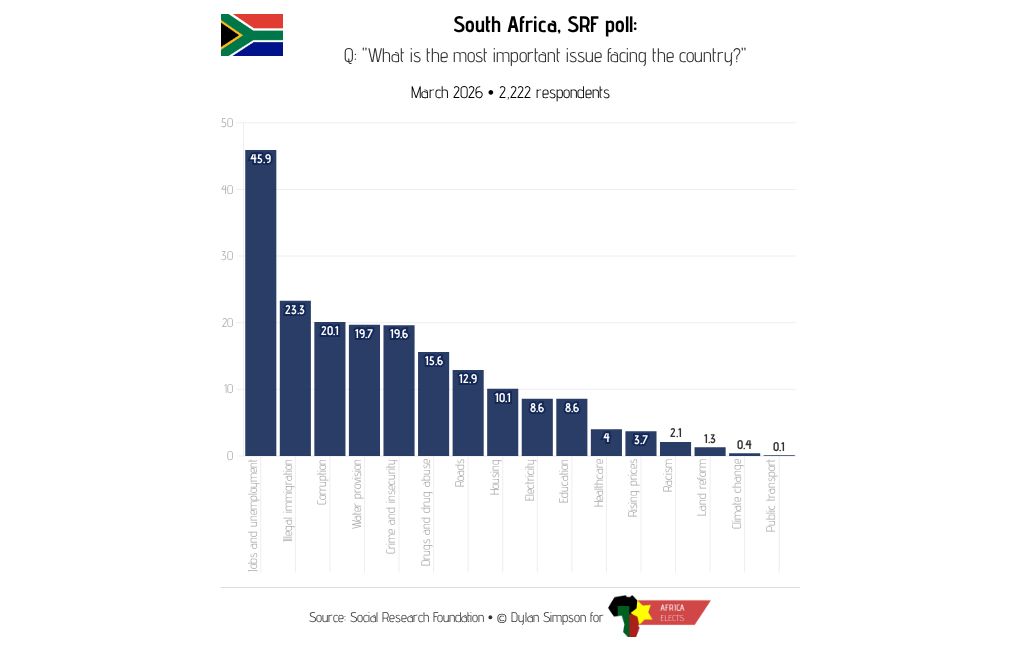
Africa Elects examines the five most pressing issues shaping the upcoming elections, and why South Africa’s persistent challenges threaten to mark this election as another chapter in the ANC’s decline.
Issue 1: The Economy
South Africa’s economic stagnation lies at the heart of the ANC’s electoral decline. This is most clearly demonstrated when examining the relationship between the ANC’s support and South Africa’s GDP per capita.
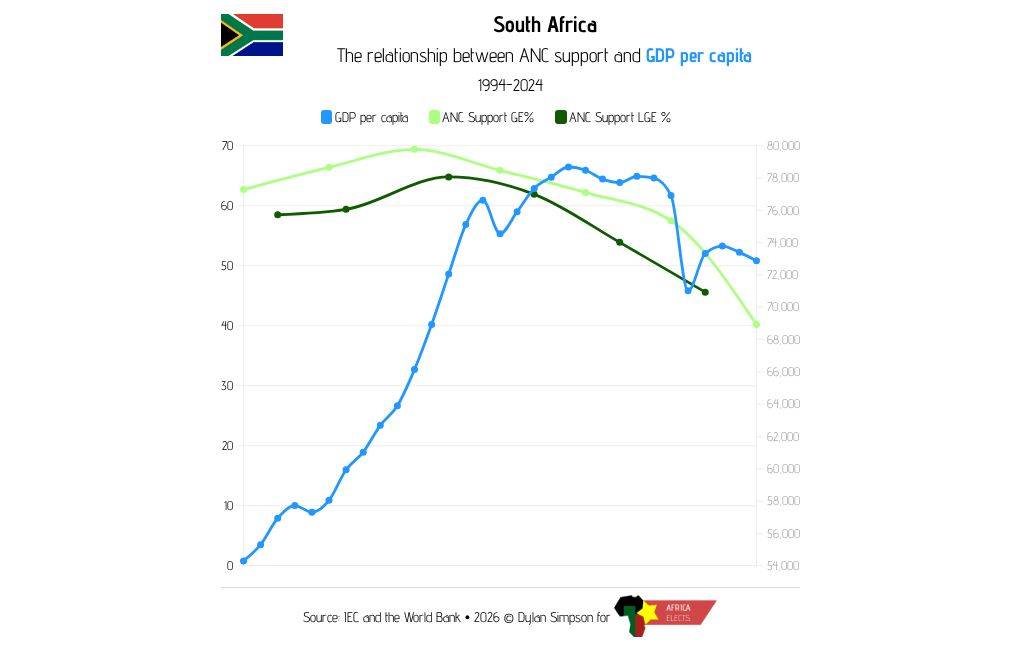
After the end of apartheid, the ANC was rewarded at the ballot box for rising wages and a growing economy. Growth was regularly above 3%. This enabled the rapid development of the country, extending basic infrastructure and sanitation to communities the apartheid state had neglected and abused.
However, as economic growth began to slow in the 2010s, the ANC’s gains began to reverse. South Africa’s unemployment remains one of the highest in the world, climbing to 33.6% this year. Voters largely see the ANC as responsible. In 2022, polling from the Social Research Foundation found that voters thought the ANC was the most “anti-poor” political party.
Under the GNU, the ANC has pointed to the end of rolling blackouts as proof that economic progress is being made, but the fact that economic growth and the crippling unemployment rate have still not improved has left much of the country hesitant to put their support back behind the ANC.
For voters who have seen little improvement in their economic circumstances, repeated promises of prosperity have become increasingly difficult to believe. Until South Africa’s economic fortunes improve, the ANC will find that its own electoral recovery remains just as elusive.
Issue 2: Immigration
For decades, South Africa has seen significant anti-immigrant violence. But anti-immigration sentiment is becoming more organised. Polls by the Human Sciences Research Council found that the number of South Africans who say they “generally welcome no immigrants” into South Africa had risen from 28% in 2020 to 42% in 2025, the highest on record. Amongst low socio-economic status South Africans, this figure sits as high as 50%.
Against this backdrop, the March and March group has emerged as the organised face of the anti-immigration movement. Founded to tackle illegal immigration, the group demanded that all undocumented immigrants “self-deport” from the country by 30 June, organising nationwide demonstrations to encourage their departure. The group attracted a large following, with at least 120 marches taking place across the country; a dozen ended in violence and more than 900 people were arrested.
Xenophobic action of this kind enjoys significant public support. Over 60% of South Africans strongly or somewhat agree that communities are within their rights to forcibly remove foreign immigrants if the government fails to do so.
For the ANC, a self-described progressive liberation movement, these anti-immigrant attitudes present a difficult electoral dilemma. Black voters who express the strongest hostility towards immigration have traditionally propped up the ANC electorally. As frustration grows, parties such as MK, ActionSA (centre-right), and the Patriotic Alliance (right-wing) have capitalised on this anger through increasingly bold anti-immigration and “South Africa First” rhetoric. The ANC consequently faces another challenge to its traditional electoral coalition, as opposition parties offer increasingly vocal alternatives on an issue the governing party has struggled to address.
Issue 3: Corruption
Corruption has hollowed out state institutions, strangling the ability of the government to perform its basic responsibilities. Voters express little confidence in it getting better, with 77% of South Africans in 2025 saying corruption had gotten worse since last year. Alongside this rampant corruption is a climate of fear. In 2025, 83% of South Africans said they fear retaliation if they report corruption, up from 63% in 2018.
Perhaps nothing illustrates the scale of corruption in SA more than the recent judicial commission of inquiry. The body — termed the Madlanga Commission after its chair, retired Constitutional Court justice Mbuyiseli Madlanga — is a large-scale public inquiry that began hearings in September 2025. It was set up to investigate shocking claims made by senior Police Commissioner Nhlanhla Mkhwanazi that the then-police minister, Senzo Mchunu, was interfering in police investigations into the assassinations of politicians.
The commission has grown from tackling these initial allegations to investigating a whole web of issues from bribery and illicit cigarette smuggling to assassination attempts and politicians’ mafia links. After years of promises to root out corruption, fresh allegations of wrongdoing threaten to reinforce the very perceptions that contributed to previous ANC electoral declines. Rather than demonstrating a break from the scandals of the past, the ANC once again finds itself fighting an election against a backdrop of corruption allegations, making it increasingly difficult to convince voters that anything has changed.
Issue 4: Service Delivery
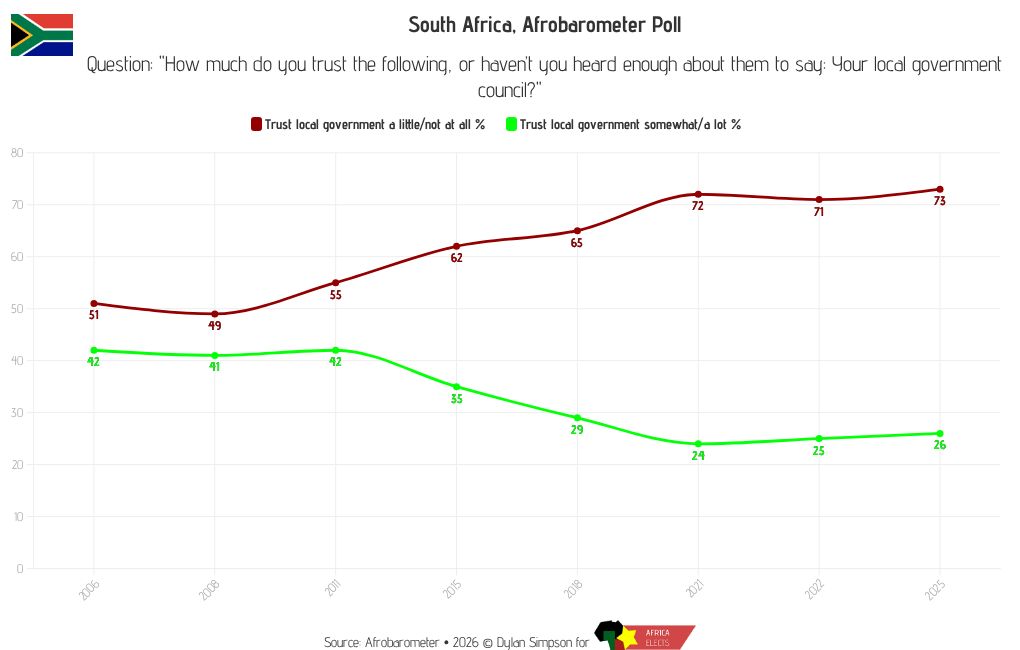
Local government in South Africa has been in disarray for years. Potholes grow, rubbish remains uncollected, abandoned buildings collapse into further disrepair, and crucial water infrastructure crumbles. In some parts of Johannesburg, citizens have gone several weeks without running water.
The polls demonstrate a collapse in the confidence people have in the local government’s ability to deliver basic services.
Coalitions in many of the major metros where the ANC is the largest party, such as Johannesburg, Ekurhuleni, and Tshwane, are filled with party infighting and a revolving door of short-lived mayors.
With the ANC winning a majority in 120 of the 205 municipalities in South Africa in 2021, the deterioration of service delivery presents a significant electoral challenge. Having dominated local government for three decades, the party has struggled to find a message of change that has resonated with voters. In every major metro in South Africa, polling suggests voters blame the ANC for the appalling state of service delivery.
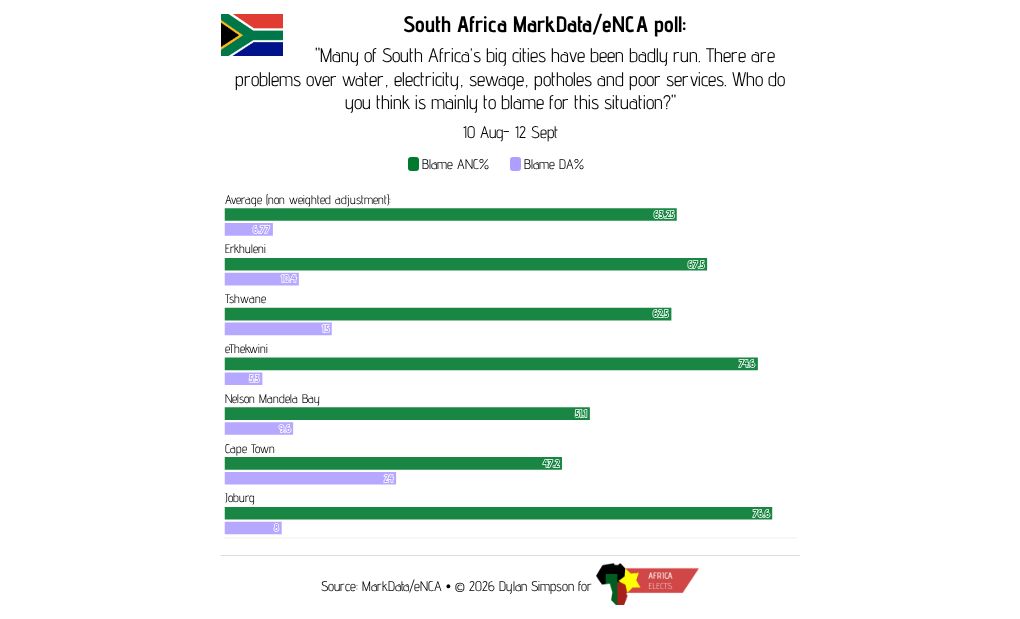
On the other hand, the DA has managed to boost turnout amongst its base and win some middle-class Black support, particularly in the urban metros, on the strength of its reputation for effective local governance. A 2026 SRF poll found that when voters were asked if “service delivery in your municipality would improve, worsen, or stay the same if the DA governed your municipality by itself and not in a coalition?” The majority said it would improve.
Most worryingly for the ANC, 39% of ANC voters thought service delivery would improve versus 24% who said it would worsen. This polling data would be depressing for the ANC to examine at the best of times, but given the party is heading into local elections where voters will be choosing politicians to deliver high-quality local governance, this must be especially troubling.
Issue 5: Crime
After apartheid, the ANC was praised for overseeing a remarkable reduction in crime, particularly murder. The instability and armed conflicts that ravaged South Africa during apartheid came to an end, the wars along South Africa’s borders ceased, and the economy grew. In 2010, however, this positive trend began to reverse.
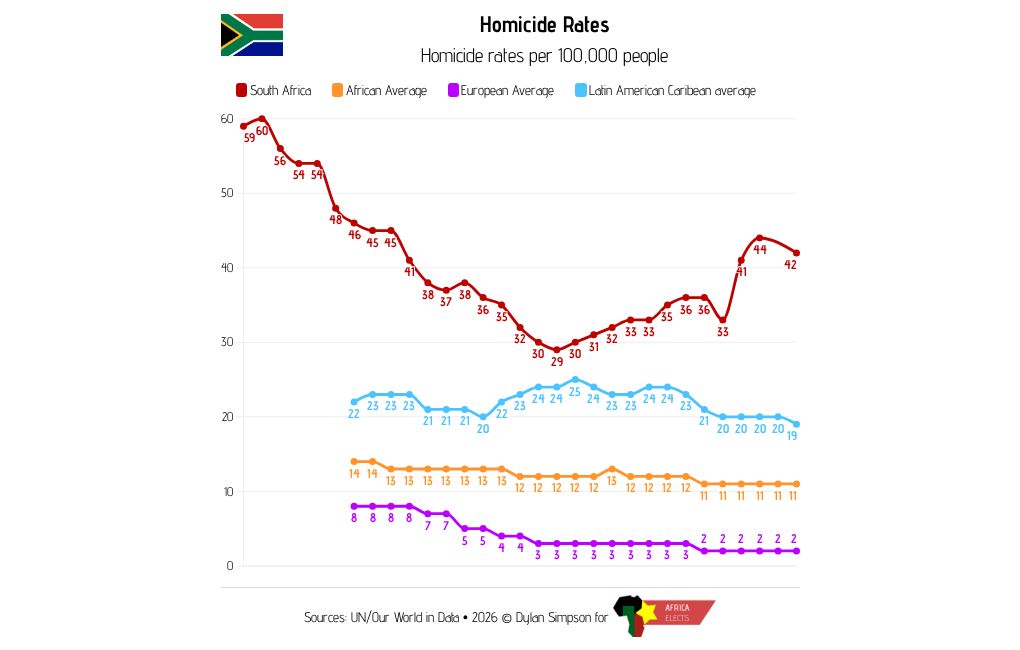
South Africa’s police force is dysfunctional. Victims of crime feel no sense of protection from criminals who routinely escape justice. The police are one of the least trusted institutions in the country, with 68% of South Africans thinking “all or most” police are corrupt.
In a 2025 Gallup poll of 140 countries, South Africa ranked as the country where people feel the least safe walking home alone at night. Just 33% said they did, down eight percentage points from a 2006 high of 41%.
The failure to tackle crime is one of the essential dimensions of the ANC’s continued decline. With policing responsibilities being a national government matter, the ANC has been unable to shake the perception that it is largely responsible for the crime epidemic in South Africa. And while policing is not a municipal responsibility, crime is so pervasive that it will almost certainly shape how people vote and further damage the ANC’s reputation.
Closing thoughts
South Africa’s political landscape has changed dramatically since 2021, but the issues driving voters to the ballot box have not. Slow growth and high unemployment, concerns over immigration, corruption and crime as well as the growing anger voters feel over the state of service delivery set the stage for another painful election for the ANC.
It faces an uphill battle in persuading voters that it can solve issues that it has overseen for the past three decades. Unless voters begin to see meaningful progress, the upcoming elections risk telling a similar story: another decline for the party that has governed South Africa since the start of democracy.