
On the 12th of April 2026, Geordin Hill-Lewis succeeded John Steenhuisen to become the new leader of the DA (liberal|centre-right). At just 39, he is the youngest leader of any major political party in South Africa but brings with him roughly 2 decades of activism and experience within the DA.

Hill-Lewis first entered organised politics as a student at the University of Cape Town, where he founded the DA’s student wing. From there, his rise was swift. He served as Chief of Staff to then-Premier of the Western Cape Helen Zille and became one of the youngest MP’s in South Africa’s history at 24. He spent the years that followed building a reputation as one of the party’s sharper economic minds, serving first as Shadow Deputy Minister of Trade and Industry and then as Shadow Minister of Finance. In 2021 Hill-Lewis pivoted to local government, becoming the Mayor of Cape Town.
While he has served in many prominent political positions, he faces the classic challenge new leaders of political parties face, turning relative anonymity in the minds of voters into support. 59% of voters say they are too unfamiliar with him to hold a view, far larger than the 13% who view him favourably and the 15% who view him unfavourably. With local elections set to take place on the 4th November, the clock is ticking to convert unfamiliarity into support by crafting a narrative that is both likeable and identifiable.
Hill-Lewis’s acceptance speech was the first step in that process, setting out his central ambition:
“To grow the DA into the largest party in South Africa.”
To achieve this, he laid out 3 main strategies, as well as a defining national priority, fighting crime.
“We must continue to show that the DA governs well – for everyone”
The DA governs dozens of municipalities, the City of Cape Town and the province of the Western Cape. This has given the party a unique platform, the ability to offer a wide scale alternative record in government to the ANC (centre-left).
The Western Cape has the lowest unemployment of any province in South Africa and boasts the highest rates of improved sanitation facilities such as flush toilets.
The largest independent wide scale survey on South African governance also paints a remarkable picture. Good Governance Africa in 2024 published a performance index for the 257 municipalities in South Africa. The Western Cape ranked as the best run province, with the highest rate of satisfied respondents and DA municipalities consistently ranking at the most efficiently run. Moreover, Cape Town ranked as the best metro in their performance outlook.
In Johannesburg, a metro outside the DA’s control, 84% believe the DA would improve service delivery if in charge.
Cape Town has also received numerous clean financial audits and was ranked as the top ranked metro in both the Municipal Financial Sustainability Index 2024 and the Governance Performance Index 2024.
In fact, the City of Cape Town under Geordin Hill-Lewis, the only metro to be run by a DA majority government, was also the only metro to receive a clean financial audit.
These achievements have been a large part of their continued electoral success. However, the last two words of Hill-Lewis’ statement — “for everyone” — make for an essential clarification.
The DA has faced sharp criticism from across the political spectrum for what is seen as their uneven record in government. Critics argue the leafy suburbs and majority-White wards in their municipalities are clean, well-managed, and receive the best service delivery, while the majority Black townships, poorer, and rural communities receive less attention from the party run by urban White elites.
While polling data does generally point to voters believing the DA run government effectively, in the Western Cape, Black voters are much more skeptical of the DA’s record in government.
A poll commissioned by the Social Research Foundation (SRF) found that 96% of White respondents said the province is managed much or somewhat better than the rest of South Africa, whereas only 48% of Black Africans thought the same.
If Geordin Hill-Lewis wants the DA to become the largest party, he will have to do more to show his record in local government is inclusive.
“We must connect more deeply with the millions of South Africans who have never voted for us before.”
There has only been one publicly available poll in South African history that has shown the DA as the largest party. The poll came from the Institute of Race Relations in late March/early April of 2025, amid the ANC’s botched attempt to increase the rate of VAT.

The vast bulk of the gains for the DA came from Black voters, traditionally the DA’s weakest electoral group. In this poll, the DA achieved a historic 18% of the Black vote, roughly quadrupling the percentage they got in 2024. When we compare this to the numbers the DA has got in previous elections, this increase is even more remarkable.
Connecting with Black South Africans, who make up 76% of registered voters, is the only realistic way to grow into the largest party.
In his speech, Hill-Lewis hinted at an important Black constituency the DA has been after for a long time.
“Most people already know that the DA governs better
Now we must win their trust, so they vote for us for the first time.”
There is a small, but sizeable share of registered Black voters who hold a favourable view of the DA but do not turn out and vote for them.
The polling numbers suggest that Black voters who view the DA favourably have a vast impact on the DA’s performance and voter coalition.
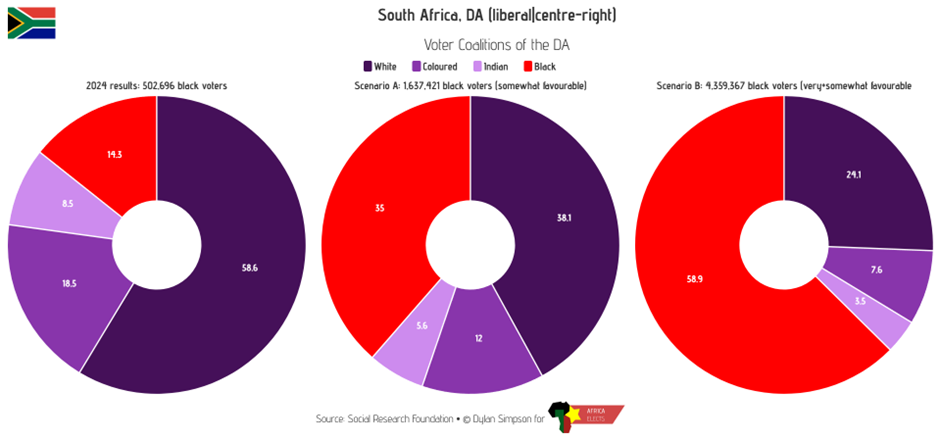
Geordin Hill-Lewis has spoken bluntly in interviews about how the DA has reached “its ceiling” with minority voters and that simply relying on higher turnout from them is not enough to grow the party. Successfully crafting a political message “for everyone” that wins over Black voters — especially those who already view the DA favourably — will be the most realistic path for the DA becoming the largest party.
However, connecting with these voters will not be easy. For any political party, good governance and delivery are only the starting point. They establish credibility, but they do not automatically translate into votes. Voters do not simply ask “who governs best?” — they ask “who represents me?” and, even more fundamentally, “who is fighting for me?”
In many democracies, this takes the form of insider versus outsider politics. A politician messages themselves as a champion of “ordinary people” against the elites. In South Africa, this dynamic takes on a distinctly racial character. Representation and interests are frequently interpreted through identity. Politics is not only about outcomes, but about belonging. For many voters, the question is not only whether a party can deliver services, but whether it will credibly connect with their lived experiences and advance their interests as an ethnic bloc.
This helps explain the durability of the ANC and why its losses have almost exclusively flowed to parties that explicitly position themselves as representatives of Black political and economic interests, such as the EFF (left-wing) and the MK (left-wing|conservative) Party. Despite fragmentation, the broad pattern of the Black vote has remained relatively stable since 1994, with new parties largely drawing from the same underlying constituency rather than reshaping it. When looking at the combined vote of parties that were created from a split from the ANC, who all claim and represent themselves as explicitly Black African parties, it paints a remarkably static picture.
The voter coalitions of the main Black parties are also remarkably racially similar.
These parties speak in explicit terms of identity and collective interest. Representation is asserted, not implied.
This is the central difficulty facing the DA. Its ideological foundation rests on liberalism and non-racialism. In principle, this allows broad appeal. In practice however, it raises a difficult question: how does a party built on universalism convincingly compete in a political environment where many voters identify more with parties that market themselves as representatives of specific groups and interests over abstract ideas of universalism?
This is reinforced by perception. Despite diverse support, the DA’s senior leadership is still disproportionately White, something which they have faced sharp criticism and allegations of racism for. Even where this may reflect internal meritocratic selection, it shapes external interpretation. For many voters, representation is not only about policy, but about who visibly embodies political power. When leadership does not reflect the demographic majority, the claim to universal representation can struggle to land emotionally.
At the same time, there is a strategic tension in Hill-Lewis’ ambitions. The more it explicitly adapts its messaging, candidate profile, or policy to broaden its appeal among Black voters, the greater the risk of alienating parts of its existing base — particularly Afrikaners and Coloured voters.
In 2015, when the DA elected its first Black leader and attempted to more explicitly message themselves towards Black voters, the party failed to make significant gains as the previous chart shows. However, the party lost support from Afrikaans voters to the explicitly Afrikaans identifying FF+ (right-wing). In this sense, attempts to expand can generate internal friction, where gains in one constituency may come with perceived losses in another. This creates a narrow operating space for repositioning without destabilising the coalition that already sustains it.
As a result, parties like the ANC, EFF, and MK can more easily frame themselves as “owning” a political constituency defined by identity and historical experience. Voters may accept that the DA governs well, but still question whether it understands them, speaks for them, or would prioritise them in moments of trade-off.
For the DA, this means that growth cannot rely on delivery alone. It must also overcome a deeper representational barrier: translating universalist liberal principles into a form of political trust that can compete with explicitly identity-based claims of representation.
That is a far more difficult task than improving governance indicators or repeating facts about GDP growth till they’re blue in the face. It requires the party not only to demonstrate competence, but to answer a more fundamental political question: in a system where many voters expect parties to represent “people like them,” can a non-racial, universalist party credibly convince a majority that it represents them too?
Without resolving that tension, the DA’s ambition to become the largest party in South Africa will remain constrained — not by its ability to govern, but by its ability to be believed as a representative force.
“Be a strong and principled partner in national government.”
Arguably the most consequential change that could come from Geordin Hill-Lewis is his new approach to the Government of National Unity (GNU). His predecessor, John Steenhuisen became embedded in the coalition as the Minister of Agriculture. Although an important position, some commentators argued it compromised the ability of the leader of the DA to criticise the ANC.
Instead of sitting around the cabinet table, Geordin Hill-Lewis will remain as the mayor of Cape Town. In an interview with Business Day he stated his three reasons for doing so were:
1. The job of Mayor has an outsized political impact and ability to improve lives
2. It would be unrealistic for him to take on a whole new role in Government and manage the DA
3. Having distance between him and the cabinet would be healthy and give him more freedom to criticise the ANC
The third reason is arguably the most important. Being outside the cabinet would allow him to be free from the political entanglements that working with the ANC would inevitably bring. While there is the potential that being outside the cabinet could hurt his visibility in national politics, with this distance between him and the cabinet he would be more freely able to criticise the ANC and the directions of the GNU, having as he put it “no sword over his neck.”
Outside the GNU, he would be able to commit to the pledge he made in his acceptance speech to:
“Fight every day to shape the direction of government so that it reflects our values.
And that is why we will continue to oppose policies in the GNU that block progress.”
He has stated that he will not “micromanage” the DA ministers in government. Instead he has appointed former DA CEO Ryan Coetzee to oversee DA ministers and Leon Schreiber, the current minister of Home Affairs to be “his eyes and ears in cabinet” while he focuses on campaigning and governing Cape Town.
National Priority — Crime
Outside of these 3 strategies, Geordin Hill-Lewis also set out his national priority, law and order. In his speech he declared:
“We must take back our streets.
We must restore faith in our criminal justice system.
And we must break the criminal syndicates that are strangling our economy and terrorising our communities.”
The focus on crime in the leadup to a local election, where policing is largely outside the responsibilities of local government may seem puzzling.
But local elections are for many voters a vote on general sentiment on the major political parties, not just a vote on service delivery.
Fear, loathing, and hatred of crime transcends political or cultural divides. When trying to build a voter coalition and uniting different groups, crime is a valuable issue to campaign on.
This focus also makes sense when considering the DA’s opposition. Most of South Africa’s major parties are mired in crime or corruption scandals. Hill-Lewis was deliberate in framing corruption as inseparable from the broader crime crisis and in doing so, every attack on corruption and criminality becomes implicitly an attack on his opponents.
The ANC’s reputation in this regard is well known. In 2022, President Ramaphosa came under intense scrutiny after millions in undeclared foreign currency hidden at his Phala Phala game farm were stolen in a burglary he never reported to police. Instead, he allegedly deployed state intelligence operatives to track down the suspects, retrieve the stolen money, and pay off the criminals, thereby keeping the incident from an official police investigation. The story resurfaced recently when an independent policing body recommended disciplinary action against two SAPS officers for their alleged role in the cover-up. More damaging still are the allegations made by KZN Police Commissioner Nhlanhla Mkhwanazi, who claims senior ANC members including former Police Minister Senzo Mchunu colluded with criminal syndicates to loot the state and stop investigations into the assassinations of local politicians.
But the ANC is not the only party with this reputation. Jacob Zuma, the leader of the MK (left-wing|conservative) party, carries the lowest favourability rating of major politicians largely due to lengthy corruption allegations. Moreover, his daughter, Duduzile Zuma, a senior MK politician, resigned from parliament amid allegations she trafficked South Africans to fight in Russia’s invasion of Ukraine.
EFF leader Julius Malema, meanwhile, is currently appealing a 5-year prison sentence for firearm-related offences and battling allegations of fraud and corruption in the VBS Mutual Bank Scandal.
While a far smaller party, the Patriotic Alliance (right-wing) will certainly be another target of the DA through this rhetoric. The PA mainly draw their support from Coloured communities, eating away into the DA’s support in recent elections.
But the PA has a reputation for being a “gangster party.” Their party leader, Gayton McKenzie, spent seven years in prison for armed robbery and their Deputy President, Kenny Kunene, spent six years in prison for running a Ponzi scheme. Just last month the DA called for an investigation into the PA’s links to organised crime.
The electoral soil is fertile for a party that positions itself in direct opposition to rivals if they can be linked to criminality.
Closing Thoughts
Geordin Hill-Lewis inherits the DA leadership at a moment of genuine opportunity. His opponents are embattled, polling is moving in his favour, and the party’s ambitions have never been set higher. But opportunity and achievement are not the same thing. To become the largest party, the DA will have to win over voters it has never reached before and quickly build approval for a leader most voters haven’t made their minds up on.
His three main strategies and focus on crime represent an attempt to meet that challenge: governing well for everyone, building trust with new voters, and maintaining principled independence from the ANC.
Whether this is enough to close the gap between the DA’s potential and its reality among Black voters will be the defining question of his leadership.