
Context
According to the Varieties of Democracy Index (V-Dem), Cape Verde has a rating of 0.74/1 making it an “electoral democracy,” indicating that the country has generally free and fair elections.
MpD
A centre-right party, the MpD currently holds a majority in the Cape Verdean parliament, winning just over 50% of the vote in the 2021 parliamentary election. After the end of single-party rule in 1991, it achieved a landslide victory in the subsequent presidential election, winning around 74% of the vote. It has historically been one of the two largest parties in Cape Verdean politics since then.
PAICV
The African Party for the Independence of Cape Verde is a centre-left party with historically socialist roots. Between 1981 and 1990 it was Cape Verde’s sole legal party, though it existed in an earlier incarnation between 1975 and 1981. The current president, Jose Maria Neves, is also a member of the party, having been elected in the first round of the 2021 presidential election.
UCID
The Democratic and Independent Cape Verdean Union was founded in 1981 by a group of Cape Verdean exiles in Lisbon, Portugal. While they have never run a candidate in a presidential election, they have contested every parliamentary election since 1995. The party has a generally conservative political orientation.
Other parties
Though smaller parties have contested some of the larger magnitude constituencies, since 2006, no party other than the three just mentioned has ever received seats in parliament since 2001.
*Note on elections
While occurring in the same year, the dates of the presidential and parliamentary elections are not synchronized, which can result in “cohabitation” where the Prime Minister and President are of different parties heading into the election.
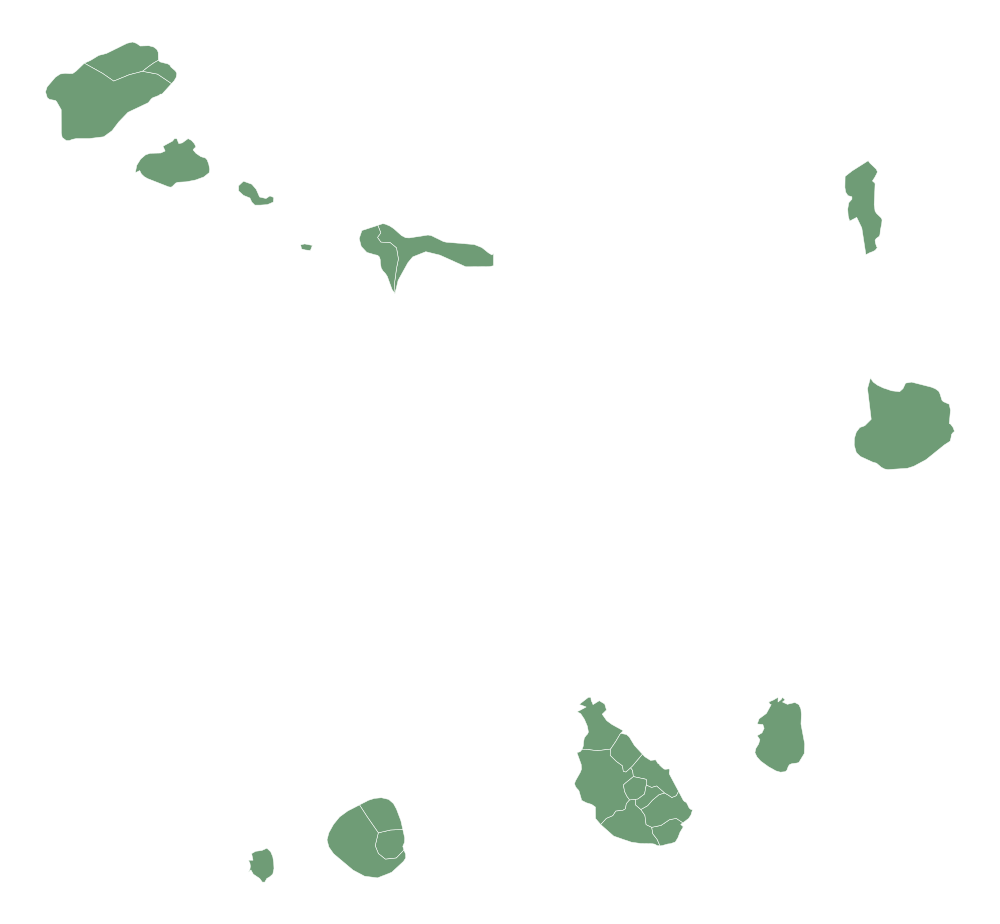
National Results
Constituency Results
Turnout by year/election
Historical Election Results (National)
National Parliament Composition
Methodology:
All data in this dashboard is sourced from Cape Verde’s official electoral authority (CNE). Historical results are compiled from publicly available CNE reports. When new official results are released, they are added manually to ensure accuracy and consistency across the series. All visualizations use a standardized Africa Elects template designed for rapid replication across countries.
Note: This dashboard may publish partial results as released by the CNE. Such results may be provisional and be certified at a later date. Certified results will be displayed after they are officially declared by the CNE. Some Flourish charts include automated timestamps. Unexpected errors may occur; treat all partial results with caution until final certification.
Africa Elects • Election Dashboard v1.0 Data: CNE (official electoral authority)
(Africa Elects is not affiliated with CNE or any electoral authority)
Last updated: 10:43, 23 May UTC